Why a Game Needs a Boundary, Even When Nobody Keeps Score
A clear boundary for a casual game makes shared space easier to use, gives play a simple restart rule and helps the group adapt without keeping score.
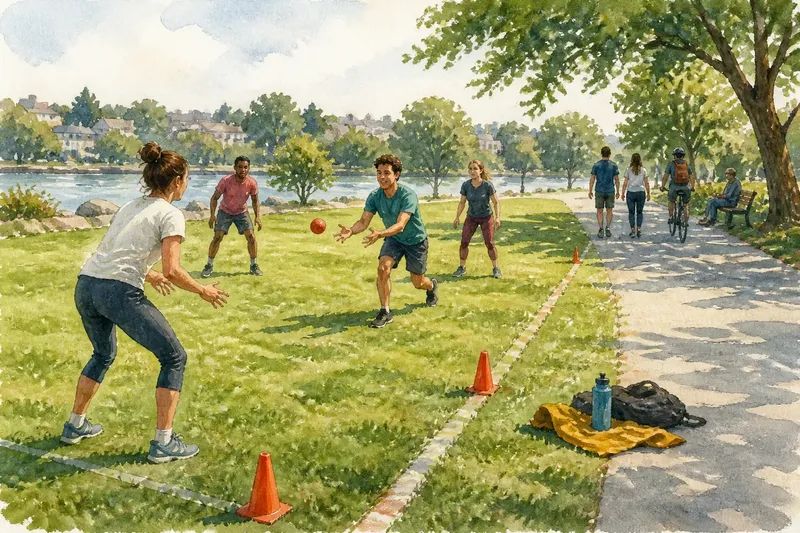
A boundary for casual play makes a shared space easier to use, even when nobody keeps score. A few cones, a chalk line or a visible change in the ground can show where the game happens and where other activity needs room.
What does a boundary settle in a casual game?
A boundary gives players one reference point for decisions that would otherwise be made on the move. The group can agree whether a ball crossing the edge pauses play, whether a player may retrieve it, and where the next turn begins.
Think of the edge like the rim of a bowl: it gives the group a clear limit without dictating what happens inside it. A boundary is not a referee and need not make a relaxed game formal. Its job is to make the playing space legible and the next action predictable.
In a park, courtyard or beach, that shared outline can also help keep the game from spreading into a route or another person’s space. Choose an edge that players can see while moving, rather than relying on an invisible line everyone may imagine differently.
How do you choose a suitable playing area?
Begin with the ground and the space around it. Look for a surface suited to the activity, room for the movement the group wants, and a clear route for other people. Avoid shaping play towards traffic, water, fragile planting or a busy path.
Make the area large enough for the game but compact enough for players to stay connected. A loose circle might suit keep-away; two end lines may make a throwing game easier to follow. Ask the people playing what feels workable, especially if the group has different movement needs, then adjust the shape accordingly.
Use markers that are visible and unlikely to trip anyone. Cones, soft bags or clothing laid flat can work in some settings; a paving seam or the border between grass and sand may be clearer in others. Keep markers outside the main running line where possible, and do not use an object that could roll or create a hazard.
How can you mark the edge and agree what happens?
Keep the setup brief. One person can point out a proposed area while another checks the surroundings. Then settle the edge and the restart rule in plain language before play begins.
- Check the route beside the area: If the boundary crosses a path or leaves no clear way through, move it or choose another spot; otherwise, keep the route open as marked.
- Check whether the edge is visible from inside the game: If players cannot see it while moving, add clear markers or use a stronger natural feature; otherwise, keep the simple edge.
- Check the ground where people will run or turn: If it is slippery, uneven or obstructed, shrink or relocate the area; otherwise, use the proposed space.
- Check how far the ball may travel: If it could reach traffic, water or another activity, shift the boundary away from that hazard; otherwise, agree a retrieval route.
- Check what counts as crossing the line: If players have different assumptions, choose one rule before starting; otherwise, state the shared rule aloud.
- Check whether the restart point is clear: If nobody knows where play resumes, choose a spot or method such as returning the ball to the crossing point; otherwise, use the agreed restart.
Say you are playing a relaxed throwing game on a lawn beside a footpath. You have two cones and can see a grass seam running parallel to the path. First, you place the cones at the far edge, then agree that the seam marks the path-side limit and that a ball crossing either edge pauses play. The nearest player retrieves it by walking around the side away from the path, and the next throw begins where it crossed. The result is a defined area and a restart everyone can follow, without introducing points or an official.
What should change when the space or group changes?
Informal games can outgrow their first layout. More players may arrive, the ground may become busy, or the group may want a different shape. Pause between turns, explain the reason for changing the edge, move the markers and check that everyone can see the new limit before play resumes.
If walkers begin crossing through the playing area or the ground becomes slippery, stop and reassess rather than preserving the original shape. Move the boundary inward, change the route of play or choose another spot. The useful decision is the one that leaves room for both the game and the other activity.
A change also needs a clear restart. State whether the current turn ends, restarts or is simply set aside, then apply that choice to everyone. This prevents a layout adjustment from becoming a dispute about whether the previous play counted.
How should players handle an unclear edge?
Set a default before the first close call. The group might pause and replay a pass if nobody can tell whether the ball crossed the line, or treat an uncertain ball as in and continue. Choose the option that is easiest for this game to apply consistently.
When a disagreement does happen, ask the players nearest the action what they saw, then use the agreed default if their accounts differ. If the same uncertainty keeps returning, pause and make the edge more visible or clarify the rule. A short adjustment is more useful than repeating the same argument.
Which boundary questions come up in casual play?
Can a natural feature mark a playing boundary?
Yes. A paving seam, grass edge or other clear landmark can work if players can identify it from the playing area. If the feature is hard to see or easy to confuse with another line, add a few suitable markers.
Should a ball touching the line count as in or out?
Choose one rule before play starts and say it plainly. Treating the line as part of the playing area is easy to remember, but the group can agree on another rule that suits the activity.
What should happen if the ball leaves the marked area?
Use the restart rule already agreed: for example, pause play, retrieve the ball by a clear route and resume from the crossing point. If that route is obstructed, stop and choose a safer retrieval path before continuing.
Can players change the boundary during a game?
Yes, if play pauses and everyone can see and understand the new edge before restarting. If the group cannot agree, finish the current turn and keep the existing layout until a shared decision is made.
How does a clear boundary keep play informal?
A useful boundary removes small uncertainties without adding a formal scoring system. Players can focus on the pass, catch or next turn because they know where play happens and what to do when the ball goes out. The shared rule also gives the group a straightforward way to settle a close call.
For casual play, keep only the limits the group needs. A visible edge, an agreed response to the ball crossing it and a clear way to share the surrounding space are usually enough. The best boundary for casual play is one the group can adjust while leaving other people’s routes and activities undisturbed.