Park Loop or Out-and-Back: Two Ways to Shape a Leisurely Walk
Choose a park loop or out-and-back walk to match your mood, company and surroundings, making it easier to pick a route you can enjoy and follow.
A park loop or out-and-back walk can make the same afternoon feel quite different. Choose a loop if changing views and a route that returns to the start appeal; choose an out-and-back if you want a clear destination and the freedom to turn when you feel ready.
Neither shape is inherently better. The useful question is what you want the walk to ask of your attention: follow a route that gradually bends home, or decide how far to go before retracing your path.
What does each route feel like?
A loop follows a circuit and brings you back near your starting point without retracing the whole way. In a park, it may circle a pond, pass a bandstand and return through a different line of trees. Changing scenery gives the walk a sense of progression, even at an unhurried pace.
An out-and-back follows a path to a chosen point and then returns along the same route. That point might be a bench with a view, a bridge or simply the place where you decide you have walked far enough. The destination is easy to understand, and familiar landmarks help you follow the return.
Think of a loop as turning the pages of a small picture book; an out-and-back is more like walking to a familiar shop and coming home. Either route can feel varied or repetitive, depending on the park, the weather and what catches your eye.
When does a loop suit you better?
Pick a loop when you enjoy seeing new parts of a place as you go. It suits a park with intersecting paths, gardens or several landmarks, especially if you would rather not pass the same pond or entrance twice. A circuit can also make a casual stroll feel complete, with a natural return to the place you began.
A loop works well with someone who likes to keep moving but does not want to choose a turnaround point. It can also hold your attention: each junction offers a small decision, and new scenery gives you something to notice. Keep the route legible rather than selecting every side path.
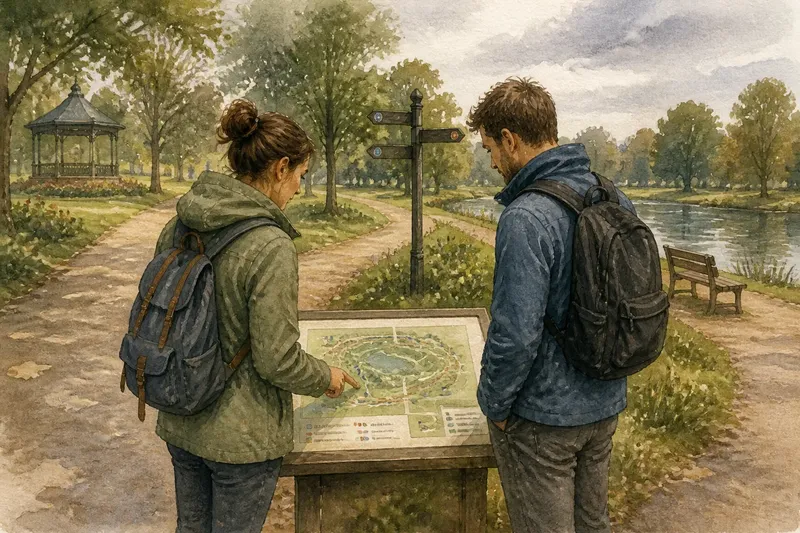
Before setting off, check the park map or signboard and identify recognisable features along the circuit. Confirm that the path reconnects with your starting area; parks may have spurs that lead away from the main route. If the map is unclear, choose a loop with visible landmarks and retrace a section rather than guess at a junction.
When is an out-and-back the easier choice?
Choose an out-and-back when you have one destination in mind or want to decide the walk’s length as you go. A broad path to a riverside seat, viewpoint or quiet clearing gives the outing a simple purpose. You can pause there and return when it suits you.
This route shape can be practical if the park’s paths are confusing or you would rather avoid unfamiliar junctions. Once you know the way out, the same gate, bridge or bend helps orient you on the return. It also suits an uncertain schedule: turn around at a natural pause rather than committing to a full circuit.
You will see the same stretch twice, but details can look different from the other direction. A slower pace may reveal a bird in the hedgerow or a garden bed you passed without noticing. If repetition does not appeal, choose a path with varied surroundings or a destination that feels worthwhile in itself.
Which route fits your situation?
- You want changing scenery: Check the map for distinct areas joined by a loop. If the circuit is clearly marked, choose it; if its junctions are confusing, take a familiar out-and-back instead.
- You have a particular place to reach: Identify a bench, pond edge or viewpoint on the map. If the path to it is easy to recognise, choose an out-and-back; if it is not, pick a clearly marked circuit.
- You are unsure how long you want to walk: Look for an obvious turning point on a direct path. If you can turn there and retrace your route, choose an out-and-back; if not, use a short, clearly marked loop.
- Your companion dislikes retracing steps: Ask whether they would prefer changing scenery. If so, choose a clear loop together; if they prefer a shared destination, choose an out-and-back and agree on where to turn.
- You want the simplest way to stay oriented: Check whether a path has familiar landmarks all the way to a turning point. If it does, choose an out-and-back; if it does not, follow a marked loop with recognisable junctions.
- You want a natural ending: Check whether a circuit returns near your entrance or meeting place. If it does, choose the loop; if it does not, take an out-and-back that leads to an easy-to-find return point.
Say you arrive at a park with a friend, a cloudy sky and no fixed schedule. You both want variety, but you are unsure how long you will stay. Check the map for a marked loop and an obvious junction; if both are clear, follow the loop to that junction and pause to decide whether to continue. If the signs become confusing, retrace the familiar section instead. The result is a flexible outing, with a clear fallback rather than a guess at the next turn.
How do you choose a route before you start?
Begin with the quality you want most: new views, a destination, simple orientation or an easy way to shorten the outing. Then check the park map for the entrance, path connections and landmarks that could serve as turning points. The route should still make sense when you are standing among the paths, not just when looking at a screen.
Notice what is underfoot and who is joining you. A wide, smooth path may suit a mixed-pace group better than a narrow route with frequent turns; a shaded path may feel more inviting on a bright day. If anyone needs a particular surface or access arrangement, check the park’s information before choosing. Follow posted signs and local guidance on access and restrictions.
Keep the plan loose enough to adapt. A loop can become an out-and-back if a junction feels unclear, and an out-and-back can include a short side path if the destination is inviting and the return remains easy to recognise. Changing course is a sensible part of a leisure walk.
What should you ask before choosing a park loop or out-and-back walk?
Is a loop harder to follow than an out-and-back?
Not necessarily, but a loop with several junctions asks you to notice signs and landmarks. If you prefer a familiar return route, an out-and-back is usually easier to keep in mind.
Can I turn an out-and-back into a shorter walk?
Yes. Choose a recognisable point as your turning place, then head back whenever you are ready. You do not need to reach the furthest landmark for the walk to feel complete.
Which route is better for walking with a companion?
Choose based on what both of you enjoy: a loop for changing scenery, or an out-and-back for a shared destination and an adjustable return. Agree on that preference before you start, so one person is not expecting a circuit while the other expects to turn around.
Can a loop include a shortcut back to the entrance?
Some parks have connecting paths that let you shorten a circuit, but check the map or signs rather than assuming a path reconnects. If the junction is unclear, retrace a familiar section instead of taking an uncertain turn.
How can you make the choice feel natural?
Do not treat the route shape as a commitment to a particular mood or distance. A loop is a good starting choice when variety matters; an out-and-back is a good starting choice when a destination or flexible turnaround matters. Once you are on the path, let the park and your company guide the pace.
Before leaving the entrance, name one thing you want from the walk: a fresh view, a quiet place to pause or the simplest route back. That small decision makes choosing a park loop or out-and-back easier, and gives you a clear reason to change course if the route calls for it.